ruth901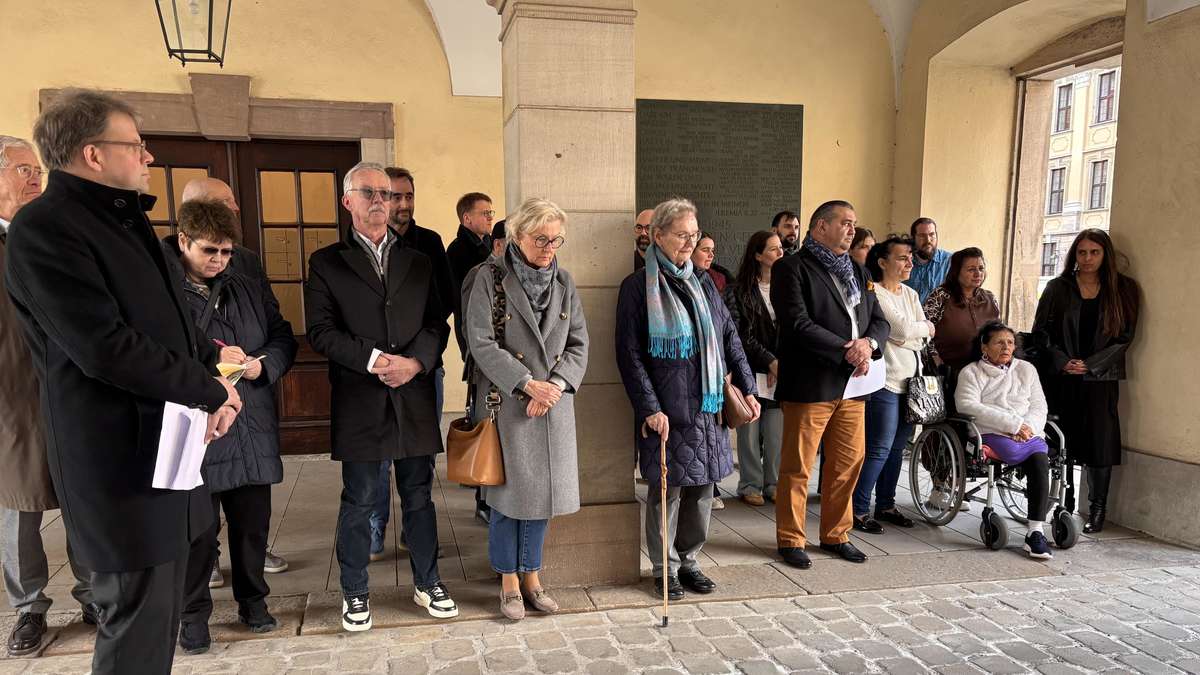

More than 125 Sinti were deported from Fulda to Auschwitz-Birkenau in 1943 – almost all of them died. A memorial event recalled their fate and warned against indifference to exclusion.
Fulda – “I suspect that the vast majority of people who rush past here don’t know what significance this place has,” said Mayor Dr. Heiko Wingenfeld (CDU). It is therefore important to continually explain what happened in Fulda and to make the darkest chapters of the city's history visible. At that time, 92 Sinti and Roma were “recorded” in the city palace. Almost all of them were murdered by the National Socialists. That's why there is a memorial plaque in the archway to the inner courtyard of the castle from the direction of Schlossstrasse/Heertor.
Fulda remembers the Sinti and Roma: A reminder against forgetting
The reason for the memorial event was the anniversary of the March 1943 deportation of the Sinti and Roma from Fulda. On March 23, 1943, more than 125 Sinti from Fulda were deported to the Auschwitz-Birkenau extermination camp – almost all of those who were living in the baroque city at that time. It can be assumed that there were no warnings and no one tried to help. Only a few of the people who were taken to concentration camps for forced labor survived. Wingenfeld emphasized that the genocide against the Sinti and Roma has not yet been sufficiently anchored in public consciousness.

The memorial day was initiated by the deputy managing director of the Regional Association of German Sinti and Roma, Rinaldo Strauß, together with Michael Brand (CDU), the Federal Government Commissioner against Antigypsyism and for the Life of Sinti and Roma in Germany. In his speech, Strauss welcomed a special guest: his aunt Agathe Schwab. The 92-year-old was deported to a labor camp with her family and had to live there for two years.
Strauss himself is, as he said, a son of survivors. He emphasized: “It is a question of respect not to talk about the millions of people as abstract victims, but to see them as individuals with families.”
Commemoration of the genocide
At the same time, he warned against drawing any conclusions. “History shows where indifference leads. That's precisely why we have to be attentive when political forces arise again in our time that exclude people because of their origin, religion, skin color or way of life,” he emphasized and added: “Right-wing or even right-wing extremists sit in our parliaments and shape politics.”
For Strauss, the focus is on one central principle: “Human dignity is inviolable. Antigypsyism, racism and anti-Semitism are not opinions, but attacks on human dignity. It is up to us to fight for a society in which hate has no place.” Since fewer and fewer contemporary witnesses can speak, it is up to us to pass on these stories.

Students from a study group run by Anja Listmann, the city's representative for Jewish life, created a particularly poignant moment. First, Clara Bohl read out the fate of August Christ, who was deported from Fulda and murdered by the National Socialists. Leni Manthey read out all the names of those who were deported from Fulda in 1943. In this way, each and every one of them could be remembered.
At the end, Florentine Schlereth had her say. She emphasized: “Minorities are oppressed not only 80 years ago, but also today,” and appealed to everyone around: “Today I would like to ask you how you as an individual deal with the weakest in our society. And if your answer does not satisfy you, I would like to ask you to stand up for openness, tolerance and respect every day.” Finally, a wreath and some flowers were placed at the plaque.

Some of the survivors gave their memories as contemporary witnesses. These are the basis for the SiRo Hessen app. There are tours through various cities in Hesse, including Darmstadt, Wiesbaden and Fulda. The tour in Fulda is around 8.5 kilometers long. Walking through all seven stations takes about 2.5 hours. The route is in the SiRo Hessen app and can be viewed on the Internet.
MIA is a civil society reporting and information center for nationwide monitoring of antigypsyism. Anyone can report cases here – even anonymously.
But how many people do such events actually reach? In some clubs and communities, fewer and fewer visitors come to memorial services – The question of how moved people today are by memorial days is answered very differently.