ruth901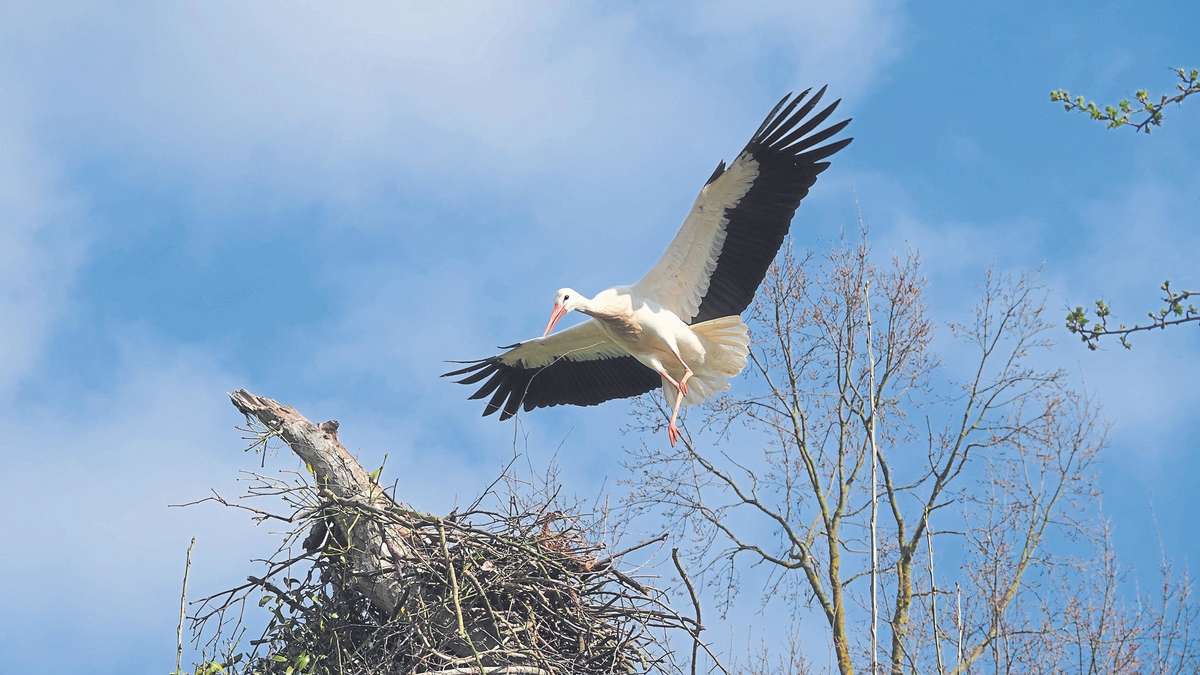

First the positive: All twelve white stork breeding sites from last year in the old Schlüchtern district are occupied again this year – unlike in the middle Kinzigtal or the western district. But that was almost it as far as the good news about “Master Adebar” was concerned.
Main-Kinzig district – There are no new settlements in the Bergwinkel district either. The unringed female stork probably died in a stork fight at the Marborn breeding site. Since this happened at the beginning of the breeding period in early March, the long-time nest owner with the ring ID “2V103” found the nest near Maberzell in the district Fulda When the egg hatched in 2019, it quickly found a new partner – and breeding was already underway.
White stork population in Kinzigtal is declining for the first time since 2000
After a preliminary breeding pair count by the stork protection initiator in the district and a volunteer from the Helgoland Bird Observatory, Werner Peter from Freigericht, the stork population is estimated Main-Kinzig district This year, for the first time since 2000, there has been a slight decline in inventory and is around ten percent below the previous year's inventory.
A further increase in the population of rattlers was actually to be expected this year, because the stork cohort of 2024, which will be able to breed for the first time this year, was also very rich in offspring in the Main-Kinzig district.
This decline is probably due to bird fluwhich caused a number of deaths during the migration season last autumn, and not just among the cranes. Back then, some dead storks were found in Hesse that had died from the highly contagious viral disease. But in the wintering areas the death of waders from bird flu continued. For example, a white stork with the identifier “3V519” that was ringed near Langenselbold on June 10, 2021 was found dead in Spain near Rivas-Vaciamadrid (near Madrid) on December 15, 2025. As the recovery reporter Jesus A. Cuevas reported, there were more than 400 other bird carcasses nearby, whose deaths were caused by the viral infection.
Bird flu has also affected a number of storks in the Main-Kinzig district
This year, some of the long-standing stork breeding grounds, especially in the western district, remain orphaned. New settlements are the absolute exception. Stork fights and nest building activities are currently still taking place in the stork colony near Gelnhausen-Meerholz.
Unlike last winter, the city of Gelnhausen did not carry out a tabula rasa felling operation when it came to pruning the poplar trees, but rather carried out the tree pruning on the west side of the poplar avenue, which was necessary for traffic safety reasons, very moderately. At the same time, the crowns were trimmed so that the storks could build nests there. At least three new pairs are currently building their nest here. Here too, the species protection intervention by Werner Peter from “Pro Artenschutz MKK” was worth it, otherwise there would not be such a positive result.
Of course there were also deaths among the storks in the breeding area. Near Hailer and Neuenhaßlau two storks collided with the train, while near Niederrodenbach and Marborn storks probably died in the competition for coveted breeding sites. On the other hand, the two “oldies” from Holland and France have started another breeding season at Nidderau-Eichen and Langenselbold. The two ringed 26-year-olds are now completing their 24th breeding in the district.