ruth901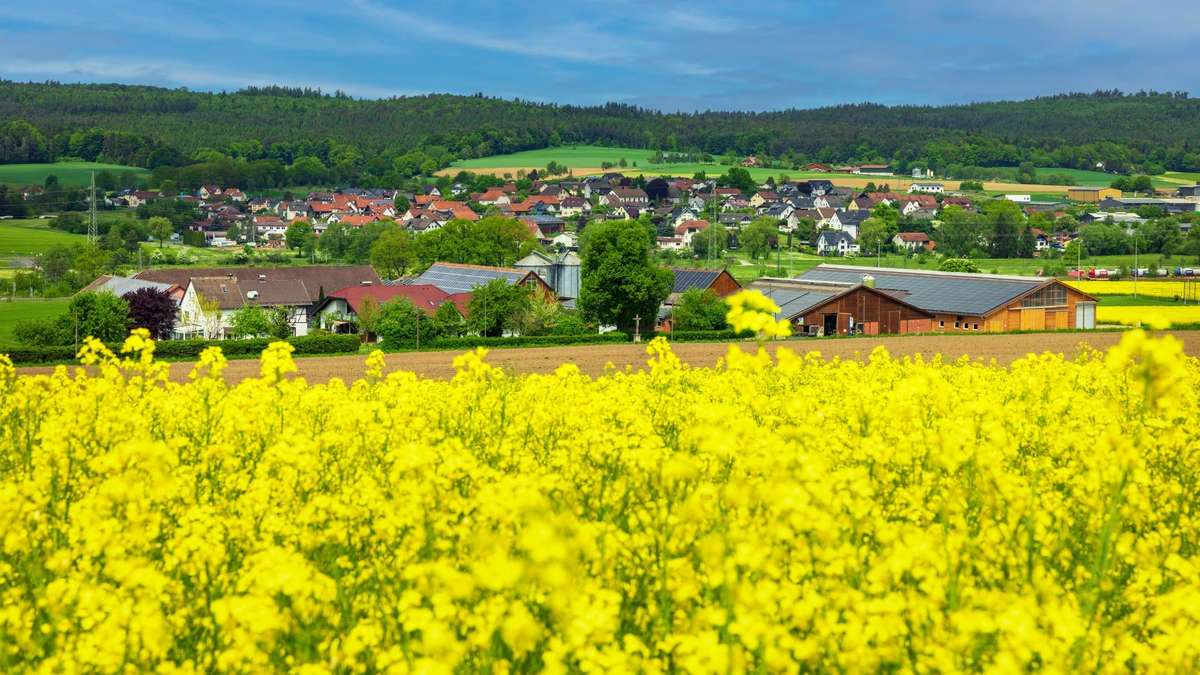

Hof Engelsburg looks back on 630 years of history. The Vogel family invests in modern technology. The next generation takes over. A court festival is celebrated at Pentecost.
Neuhof – The Engelsburg farm is located on the edge of Neuhof in the direction of Hattenhof and is probably familiar to many drivers who regularly drive on the A66. The estate will be 630 years old this year. There is also a connection to the Stiffoller emigrants. Johann Schrimpf from the Engelsburg farm near Neuhof, born in 1718, moved to Szűr/Hungary.
Hof Engelsburg has been owned by the Vogel family since 1902 and is now passing into the fifth generation of the family. “It was always important to me that we managed the farm as a team and that we also had freedom for the family,” says Michael Vogel. In 1994 he took over the Engelsburg farm between Neuhof and Hattenhof from his father Anton, who had run it since 1966.
Fifth generation takes over: Hof Engelsburg celebrates Pentecost
Now, with Samuel, his youngest of three sons, the next, fifth generation of Vogels is in the starting blocks. It was important to him that he handed over the business to the 27-year-old junior in a sustainable manner, says the 61-year-old. This meant another investment in the farm for the family.
The Vogels have just put a new stable for dairy cattle into operation – fully automated. There is space for 70 cows in the spacious, well-ventilated, open wooden building, which is clearly visible from the A66. It is housed in it an AI-controlled milking robot in which the cows are not only milkedbut whose udders are then cared for directly.
The robot, which is equipped with a 3D camera and sensors, even recognizes when the milk needs to be transported to the neighboring stall to the calf and when a cow is ready for insemination. With the feed control they are also guided into the appropriate boxes.

The new stable is not just about making work more efficient on the farm. “The aim is that the milking robot in the stable can be managed by one person. But we also attach great importance to emission-free operation. In the stable, the animals' feces and urine are strictly separated in order to prevent the formation of methane gas,” explains Vogel.
He and his son also see it as a matter of course that the energy mix on the farm is right – for example, including the use of photovoltaic systems. “And ultimately, we only keep as many animals as we can supply with self-produced feed. Conversely, we hardly have to buy any fertilizer because there is enough of it. The circular economy is our ultimate goal,” explains the farmer, who also works in meat inspection at the district's veterinary office.
Castel Sant'Angelo was first mentioned in a document in 1396
Under these conditions, son Samuel could continue the business “just as we have shown him.” After all, in addition to the 70 mother cows in the stable, there are also old and breeding cattle as well as fattening pigs. Cattle breeding has always been part of the tradition at Engelsburg, which was one of two estates that supplied the princely moated castle in Neuhof. The Erlenhof was once responsible for the grain – today it is located between Neuhof and Schweben.
So it is hardly surprising that the first written mention of Castel Sant'Angelo as “Engelnhof” (Angilhelm's Court) was in 1396 in connection with the then Prince Abbot John I of Merlau. After the farm belonged to the Lords of Schletten from 1530 to 1568, it passed to the Fulda prince abbot Georg Schenk von Schweinsberg. In the following years there were several changes in owners and residents – including, from 1876, the railway lineman Damian Herbert.
Castel Sant'Angelo celebrates court festival on Whit Monday
The Vogel family is celebrating the 630th anniversary of Engelsburg (Hattenhofer Straße 32) in Neuhof with a courtyard festival on Whit Monday (May 25th) from 10.30 a.m. The festival begins with a church service in the courtyard. The greetings will follow at 11:30 a.m.
The festival starts at 12 p.m. with music from the Lichtbergkrainer, lunch and draft beer. Tours of the new stable, a children's program, a farm café and information stands from participating companies are offered. The proceeds go to the Neuhof parish for the church tower clock and to the Fulda children's clinic.
The farm, not far from the Fulda-Frankfurt railway line, has now been run by the family for 124 years. In 1902, Michael Vogel's great-grandfather Ferdinand bought the property from Levi Nußbaum. “Ferdinand Vogel always tried very hard to adapt his 50-hectare farm to agricultural development,” says a timeline that has been hanging on the farm since the 600th anniversary celebrations.
And his succession plan was also well made: If the first-born son Josef, who was entitled to take over after the inheritance, did not initially want to take over the business, a wise decision was required when he decided otherwise. Without further ado, Ferdinand also secured a livelihood for the second-born with the Sulzhof near Kerzell.
Samuel Vogel is the fifth generation of the family to take over
When Michael Vogel now hands over Castel Sant'Angelo to the fifth generation of the family, he does so with peace of mind. He will be at his side when his son Samuel takes over the family business with two employees, one of whom once came to the partner company through Antonius.
Today he is well integrated on the farm. “Because a business like this only works in a team. It's just like volunteer work,” says the former CDU parliamentary group leader in the Neuhof municipal council, who only retired from the front line in local politics after 33 years.