ruth901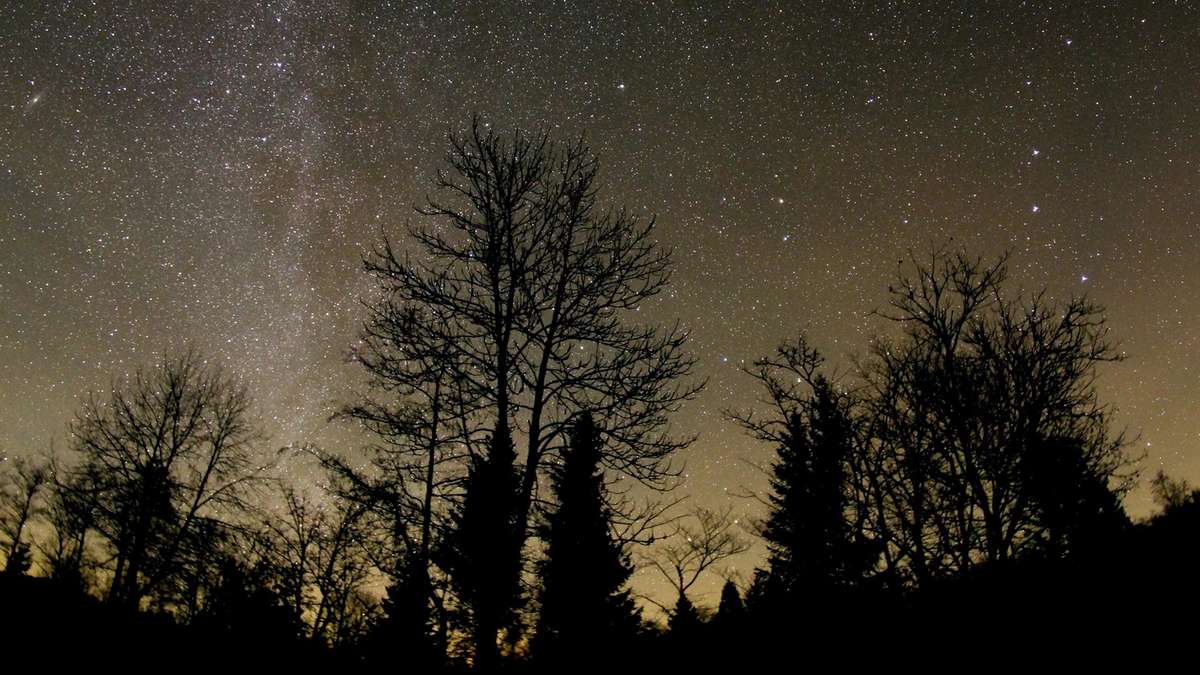

A hands-on activity in the Unesco Rhön Biosphere Reserve invites you to look at the night sky until April 20th. “Globe at Night” enables citizens to scientifically record light pollution.
Hilders – From April 13th to 20th, 2026, the world's gaze will increasingly be directed towards the sky. The International Dark Sky Week is dedicated to natural darkness, twinkling stars and the responsible use of artificial light. Citizens of the UNESCO Rhön Biosphere Reserve are also invited to take an active part.
The international participation campaign “Globe at Night” aims to record the brightness of the night sky on clear nights based on the visibility of certain constellations. These observations are reported online and incorporated into a global scientific evaluation, says the Rhön Biosphere Reserve, which also invites you to a cross-border stamp hunt.
“Globe at Night”: UNESCO Rhön Biosphere Reserve invites you to take action
“A quick look at the sky is enough: the date, location and the number of visible stars are transmitted via a user-friendly application. This creates an up-to-date global map of the nighttime sky brightness,” it says. Over 14,000 observations were submitted worldwide in 2024 and the goal is to reach 20,000 reports in 2026.
The data collected allows scientists to better understand changes in night-time lighting conditions and to study the effects of artificial lighting on nature, the environment and human health.
“Globe at Night” is one of the largest international citizen science projects on the subject of light pollution and is supported by DarkSky International, among others. The Rhön received the award as an International Star Park from this organization in 2014which celebrates their natural night landscapes, which are becoming increasingly rare worldwide.
A project for everyone – and especially for the Rhön
As a cross-border UNESCO biosphere reserve in Bavaria, Hesse and Thuringia, the Rhön has a special responsibility for protecting natural resources, which also include dark nights. Artificial light, which is scattered into the landscape primarily from settlements and is reflected on clouds or dust particles, changes the natural light-dark rhythms.
This nighttime brightening affects ecosystems in many ways: it can disrupt the orientation system of nocturnal animals such as hedgehogs, bats, owls or moths and also affects diurnal species such as songbirds. Habitats are lost, feeding and reproduction are impaired, and ecological balances are thrown out of sync.
Explore the Rhön Biosphere Reserve via app
With the app “Rhön Biosphere Reserve” you can easily explore the transnational UNESCO biosphere reserve digitally. A 3D map offers tour and excursion tips, and a routing tool records hiking and cycling routes. The app provides valuable information about Rhön nature, behavioral tips and a “virtual panorama” for an all-round view – also available in offline mode. The free app is available for iPhones and Android devices in the app stores.
The administrative offices of the biosphere reserve, together with their partners in the Rhön Star Park, are committed to a more responsible use of artificial lighting – including through information work, advice and concrete measures to reduce light.
Participation in “Globe at Night” is a simple yet effective contribution to making this concern visible. And this is how taking part in “Globe at Night” works: First, you open the website with your smartphone app.globeatnight.org There you enter the date and location, which is important for the correct display of the sky. In the next step you select a constellation, with the Leo constellation being particularly suitable in April.
Feel free to repeat the observation at several locations
Finding maps on the Internet or on the homepage of the Unesco Rhön Biosphere Reserve are helpful www.biosphaerenreservat-rhoen.de. The third step is to count the stars. A section of the sky is displayed and comparison graphics with different numbers of stars appear underneath. You choose the representation that comes closest to your own observation.
Fourth, you enter the current degree of cloudiness and send the observation. The Rhön Biosphere Reserve recommends repeating the observation at several locations. Further information on the scientific background, light pollution and an interactive world map with current evaluations can be found online at Globe at Night website.