ruth901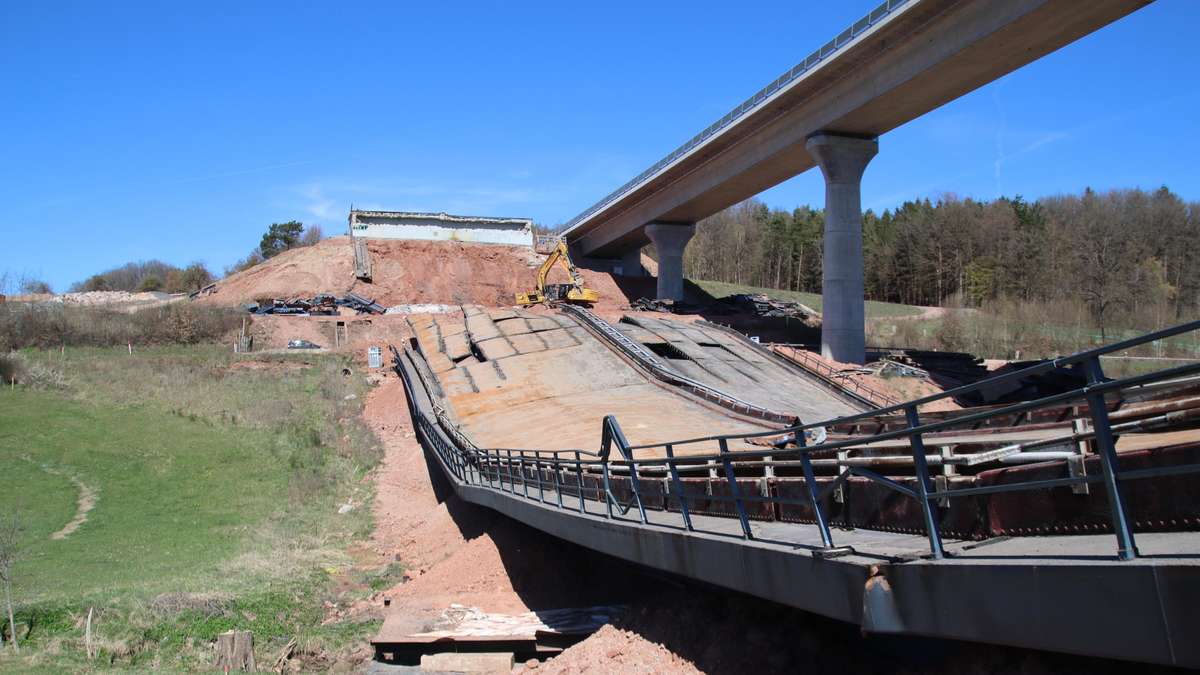

Metallic screeching, sparks flying – on the blown-up Thalaubach valley bridge, workers cut the remains into “handy” pieces with cutting torches. The dismantling is in full swing.
Döllbach – From a distance it looks a bit like a huge puzzle. Using a cutting torch makes huge pieces cut from the bridge blown up on March 15thloaded onto a truck with an excavator and then transported away. Little by little the colossus disappears from the valley. The initial priority was to clear the B 279 – that worked too.
On April 2nd – one day earlier than originally planned – the work was completed and the road was reopened. She suffered no damage.
Visit to the construction site: The Thalaubach Bridge is being demolished
The construction workers are currently working on ensuring that the cycle path can be reopened. This is planned for April 24th. “It was planned that way from the beginning, and it looks good that we will manage it,” says Jakob Gossen, head of the replacement structures division at Autobahn GmbH. “Our goal was and is to open the federal highway before Easter and the cycle path before May 1st.”
After the cycle path has been opened, the area above the Thalaubach will first be cleared. This is currently covered by a protective structure and can flow unhindered. “We don't currently have any flooding. If the blast had been in November, we would have had to prioritize differently,” said Gossen. This will be followed by the complete dismantling of the remaining parts of the bridge, including the so-called abutments, i.e. the parts that form the transition between the bridge and the road. Overall, the work should be completed by the end of June. “Due to progress, I assume that we will be able to do this sooner,” he looks ahead.
Dealing with the steel of the bridge is particularly demanding. “Concrete can be crushed relatively easily with an excavator. But steel has to be cut – and that's not a thin material, it's thick sheets of metal,” said Gossen. The cutting torches required for this reach temperatures of more than 1000 degrees.
The safety requirements are correspondingly high: “They have to be trained people with special protective clothing and masks with filters because gases are also produced when cutting.” Piece by piece, the workers cut large rectangles out of the construction, leaving a connection at one corner – only when the excavator grabs the part is this last point severed. This means nothing falls to the floor uncontrollably.
2000 tons of steel and 6000 tons of concrete are cleaned up
In total, around 2,000 tons of steel and around 6,000 tons of concrete are produced. A total of around 400 truckloads are needed to remove the entire bridge. The steel is melted down and recycled, the concrete is broken into gravel. “We try to recycle everything as much as possible. We want to put as much material as possible back into the cycle,” emphasized Gossen. The gravel can then be used on other construction sites or, for example, in road construction as the bottom layer on district or state roads.

Since the bridge was blown up and not dismantled conventionally as originally planned, construction of the new bridge could already begin. This will save us about half a year of construction time,” explains Gossen. The pit has already been dug for the so-called cycle cellar – a kind of workshop in which the new bridge is cast in sections and then hydraulically pushed forward piece by piece.
The goal is a long-lasting construction. “The bridge is built so that it can be reinforced from the inside if the traffic load increases more than expected.” The project should be completed in about two years. “Then there will be a new bridge here – and hopefully we will have peace for 100 years,” said Gossen.