ruth901
After saying goodbye to Batic and LeitmayrThis is how the Munich “crime scene” continues now
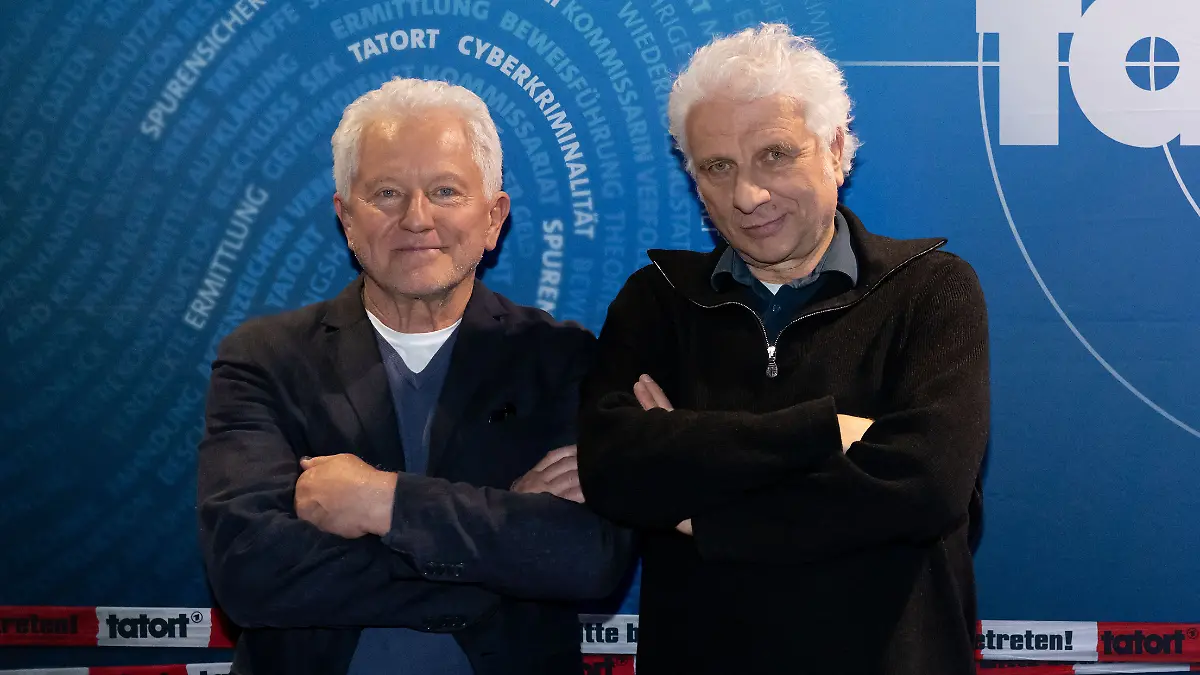
Miroslav Nemec (l.) and Udo Wachtveitl at the premiere of the last Munich “crime scene”.
Sven Hoppe/dpa
With the farewell to Batic and Leitmayr, an era ends in Munich. But the BR is not relying on a hard new beginning for “Tatort”: Kalli Hammermann, who has been there since 2014, is supposed to shape the transition as a familiar figure. His new colleague Nikola Buvak could also be seen.
Batic and Leitmayr shaped an era
Batic and Leitmayr are not just another investigative duo ending up in Munich. It's a television partnership that has shaped the Munich “Tatort” for decades: two characters whose friction, reliability and dry humor were almost as important for many viewers as the cases themselves. That's precisely why the upheaval after their departure is delicate.
Bayerischer Rundfunk doesn't rely on a cold cut, but rather on a transition with a face – and that face is called Kalli Hammermann. Ferdinand Hofer (32) has been part of the Munich “Tatort” ensemble since 2014; At that time he joined “At the End of the Hall” as a young assistant. More than ten years later, the young figure has become the person who can now be described most clearly as to how the old Munich “crime scene” is to become a new one.
This is more than just a personal characteristic. Hammermann wasn't the loudest figure in this cosmos for years, but perhaps that's why he was a particularly grateful one. He never came across as a great alternative to Batic and Leitmayr, but grew alongside them. At first, Kalli was the younger one in the room, sometimes a little more clumsy, often the one who oscillated between respect, ambition and quiet insecurity. Over the years, however, the figure gained an increasingly clear profile.
The assistant became an investigator with his own attitude, with greater presence and increasing confidence in the team. Hofer himself has described in interviews that this development is not only read in from the outside, but is also thought of internally: In recent years, efforts have been made to further develop Kalli; Now he’s “going to the next level”.
This is precisely where the real elegance of this transition lies. According to Batic and Leitmayr, the Munich “crime scene” doesn’t start from scratch. He also doesn't try to replace their chemistry one-to-one – which would be impossible anyway. Instead, Hammermann puts a figure in the front row that the audience has known for a long time and who at the same time was never so overpowering that he himself stood for a closed era. Hofer himself emphasized in an interview with the Augsburger Allgemeine that defining Munich elements such as humor and local color should be retained. An important indication of the direction in which BR is thinking: instead of a complete reinvention, a carefully modified profile with a familiar basic temperature.
Nikola Buvak is the new one
Part of this baton is that the new partner doesn't appear completely out of nowhere. Carlo Ljubek (49) takes on the role of Nikola Buvak, a SEK shift leader who is supposed to investigate alongside Hammermann in the future Munich team. The first joint case has the working title “Between Worlds”; In it, Hammermann and Buvak meet in a murder case in Neuperlach. What is interesting is that Buvak is not only introduced to the audience after the farewell, but has already become visible as part of this Munich world. In the finale of “Unvergelich Part 1” Buvak is already there as the head of a SEK unit.
For the audience, this transition is unlikely to be smooth and certainly not emotionless. Anyone who has accompanied Batic and Leitmayr for decades will not simply brush off their interaction and move on to the order of the day. The fall height of this farewell is too great for that. But that's exactly why the decision for Hammermann as the central figure of the new beginning seems plausible. It does not represent forgetting the past, but rather a future that develops from it.
Source used: spoton news