ruth901
Huge carcass is examinedDead giant! Whale autopsy begins on Danish island
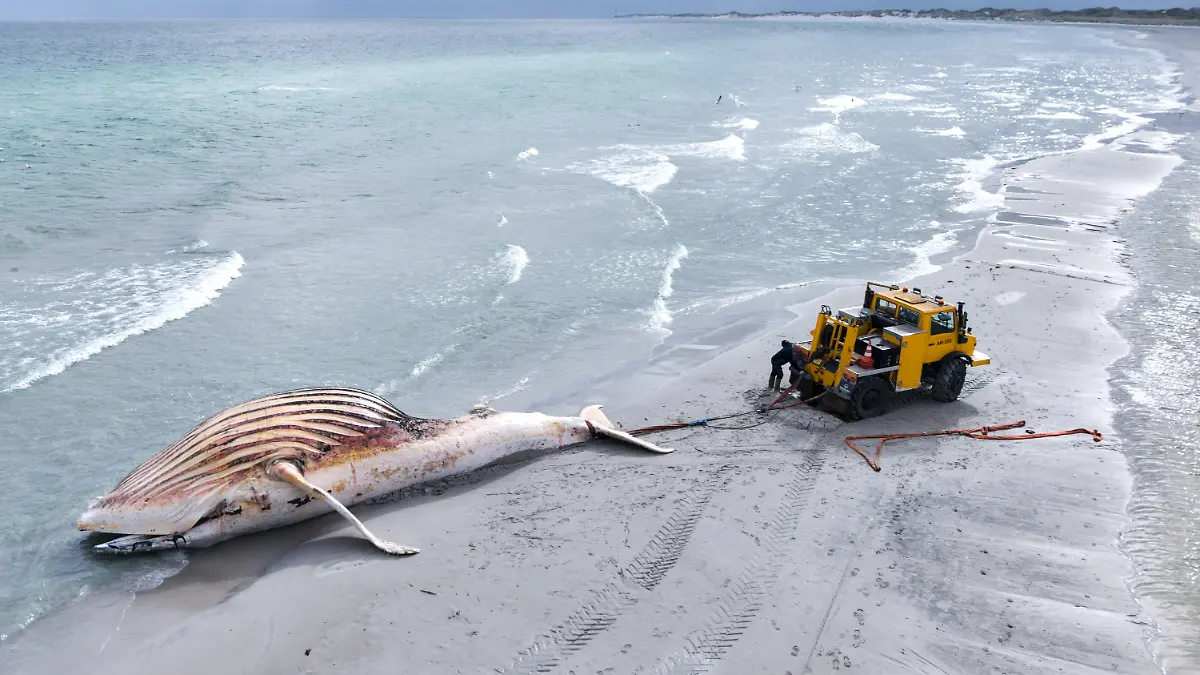
dpatopbilder – May 30, 2026, Denmark, Anholt: The dead whale is pulled ashore on the Danish island of Anholt. It is the humpback whale known as Timmy, which was stranded off Timmendorfer Strand for the first time at the end of March and was transported to the North Sea around a month later. (Aerial view with a drone) Photo: Marcus Golejewski/dpa +++ dpa-Bildfunk +++
dpa
Measuring, cutting, removing, analyzing: On the Danish island of Anholt, the experts are finally getting to grips with the whale carcass. First they let air escape from the body, then they open the dead animal. Authorities and researchers from Germany are also watching with interest.
With a scrutinizing eye – equipped with protective suits and a note board – the experts examine the yellow-brownish carcass of the humpback whale. Then it's time to measure and cut. The eagerly awaited autopsy of the whale on the Danish holiday island of Anholt has begun after a long wait. Onlookers and members of the media gathered around the animal, which has been making headlines for weeks. The carcass was then cut open with an elongated knife to release air from the very bloated animal. The whale was then opened and cut up. Organs and intestines were already lying around the animal.
The body of the animal, which weighs several tons, has been lying off the holiday island for several weeks, heavily bloated with putrefactive gases and mauled by seagulls. If you want to watch, you have to have a good stomach. For safety reasons, spectators must keep enough distance. There is a strong smell towards the sea in the wind.
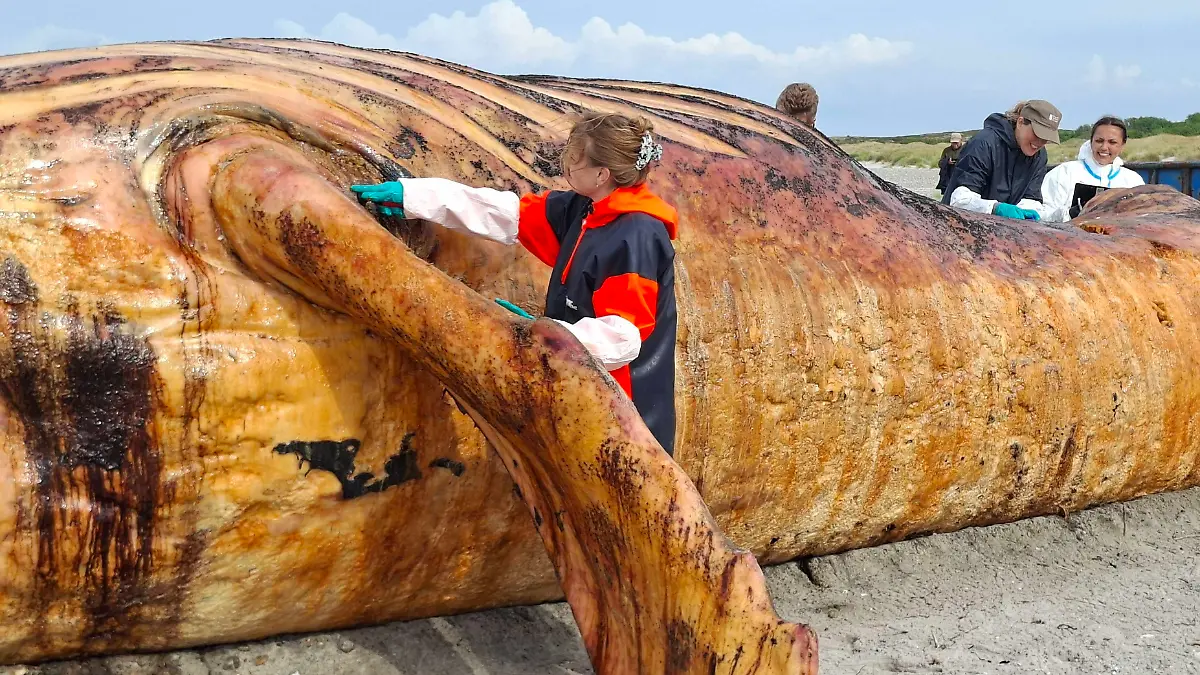
The autopsy of the humpback whale on the beach on the Danish island of Anholt has begun.
picture alliance/dpa / Kai Moorschlatt
The team of experts works without masks. “We have worked together on many stranded whales in Denmark, so we are actually all used to the smell,” said Danish researcher Charlotte Bie Thøstesen, who is involved in the necropsy.
The Environment Ministry of Mecklenburg-Western Pomerania is also observing the autopsy from a distance, a spokeswoman said. We are in contact with the local authorities. The environmental protection organization Greenpeace and the German Oceanographic Museum based in Stralsund also want to be there via stream – and are insisting on the results of the autopsy.
The experts want to find out what killed the humpback whale, which has been making headlines for weeks. Finally, it should also be clarified whether the whale – as already suspected – is actually a female. Among other things, it is also planned to take skin samples for a DNA test. Allotted for this was around six hours.
According to expert Thøstesen, studies like this are particularly valuable for science. Humpback whales are therefore animals that are difficult to study in their natural habitat in the sea. “So when we find stranded whales here in Denmark, we use them to gain insights into the wildlife,” she explains. The Maritime Museum in Stralsund also wants to request the results of the autopsy.
According to the expert, the animal's bones will also be removed – and at least some of them will go into the collection of the Natural History Museum in the Danish capital Copenhagen. “We will not preserve the entire skeleton of the whale, but only certain bones,” explains Thøstesen. These include fin bones or pelvic bones.
The carcass of the humpback whale is expected to remain on the Danish island of Anholt at least this Thursday. Even before the autopsy began, a spokeswoman for the ferry company Anholt Greena said. The removal from the island planned for today or tomorrow has been postponed indefinitely.
The remains of the carcass are expected to be transported from the Danish island of Anholt early next week, said Morten Abildstrøm from the Danish Nature Management Agency. Locals want the whale to disappear. They fear it could scare away bathers at the popular beach.
Sources used: rog/jwu/dpa