ruth901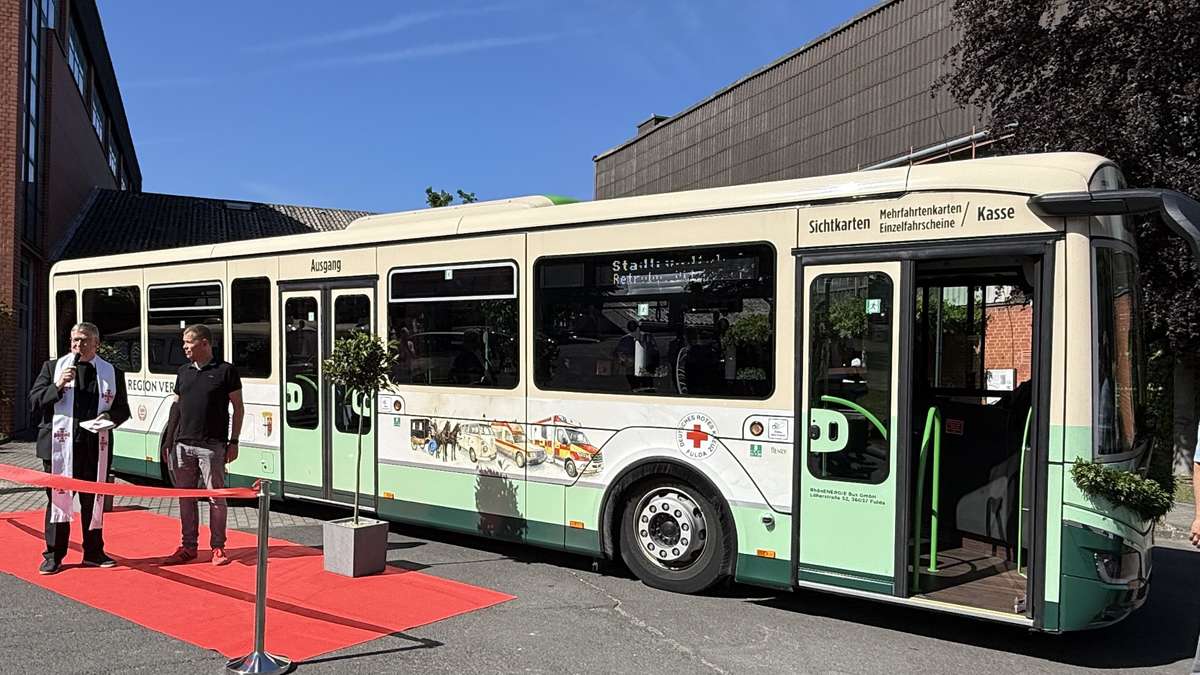

The city bus, which will drive through Fulda in the coming months as an ambassador for the German Red Cross, is printed with historical DRK motifs. The vehicle was already noticed during a city tour.
Fulda – A carriage, a VW T1 – better known as a Bully -, a Mercedes long-high ambulance and a modern ambulance can be seen on the flank of Henry. Henry – this is how the DRK Fulda named the retro city bus after the Swiss businessman and founder of the Red Cross Henry Dunant – is now driving through the baroque city. On Thursday (May 28th) Prelate Christof Steinert and Pastor Stefan Bürger blessed the vehicle and all those who will travel with it.
“They used to say omnibus, and that means: for everyone. The city bus and the Red Cross have that in common: they are there for everyone,” emphasized Steinert before the blessing of the city bus. “In life, like a bus, we have to stop and pause again and again. And at such stops in life I have always seen helpers from the Red Cross or other aid organizations,” Bürger drew another parallel.
With the DRK retro city bus to Fulda's health locations
Then the “retro bus” set off on a city tour, which was very popular with the public. He was escorted by the DRK motorcycle squadron. He had two DRK VW T1s in tow. The tour took the small column from the fire brigade museum, where the blessing took place, via the cathedral, the Heilig Geist senior center, the old municipal hospital with the former DRK vehicle hall (today the music school and Bornlepp of the Florengässner Brunneneche), the St. Lioba senior center and the Sacred Heart Hospital on Frauenberg to the Fulda Clinic.
Condensed city guides with informative explanations and amusing anecdotes and anesthesiologist Dr. Michael Wuttke the travel times due to the early evening traffic. He reported on the medicine in the former monastery and some of the charlatanism in the medieval markets, the care in the senior centers and the developments in the rescue service. It became clear again and again that Fulda was always pushing forward medical development and care – sometimes against some resistance.
Wuttke described the importance of intensive care medicine as well as the stationing of the Christoph 28 rescue helicopter from the ADAC air rescue in Fulda. He himself flew as a doctor on the first mission of the helicopter, which was called out during the commissioning ceremony.
In the hangar, the guests ended the event with a lively exchange before bus driver Eckhard Diegelmann drove the DRK bus back to the fire brigade museum. He is also a real DRK veteran who knows how to drive with blue lights on, emphasized the managing director of the DRK Fulda district association, Christoph Schwab, who was satisfied with the extraordinary city tour.
A project for emergency medical care was only recently decided upon. The new rescue station of the DRK district association Hünfeld is expected to cost 2.6 million euros.