ruth901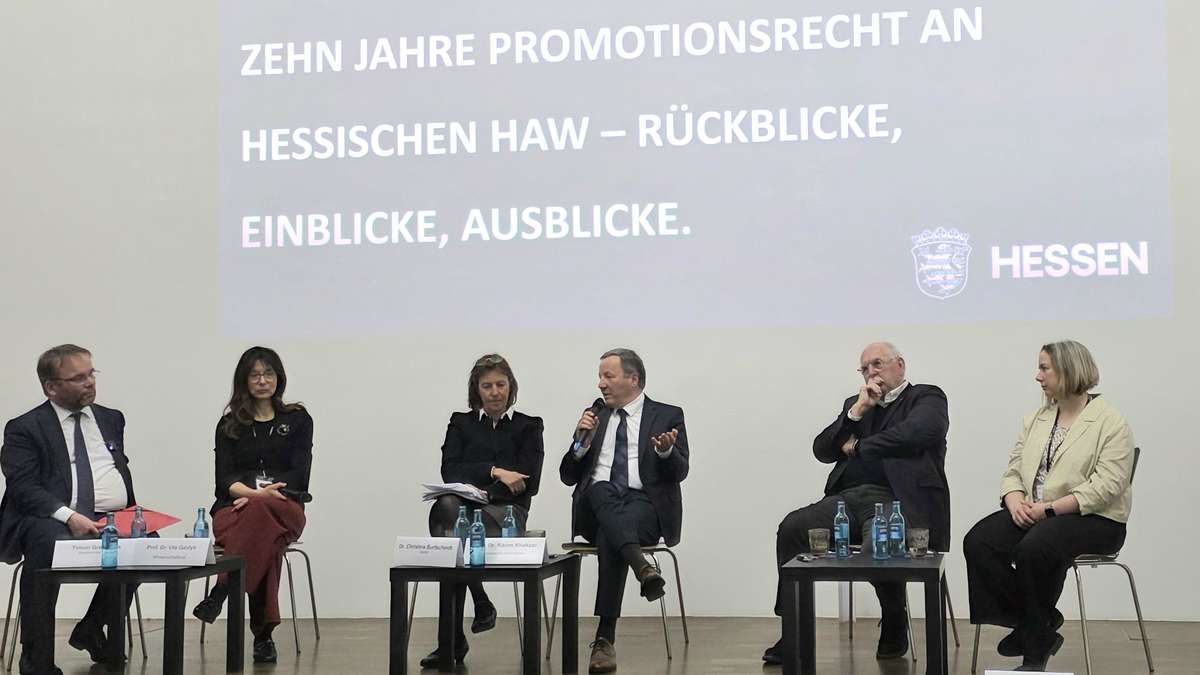

A small revolution began ten years ago. Hesse's universities of applied sciences were given the right to award doctorates. They set standards for all of Germany. Fulda University was a nationwide pioneer in independent doctoral law.
Fulda – Ten years ago, Hesse broke new ground: it was the first federal state to give its universities of applied sciences (HAW) the opportunity to obtain independent right to award doctorates in high-research areas. Fulda University was the first university in Germany to receive this right.
At the invitation of the Hessian Science Minister Timon Gremmels, the Hessian HAWs celebrated the introduction of the independent right to award doctorates at their universities and looked back at the successful model, which has now set a precedent in almost all federal states, at a panel discussion in Wiesbaden.
Ten years of right to award doctorates: Fulda University as a nationwide pioneer
“In 2016, the granting of the independent right to award doctorates to a university of applied sciences triggered a small revolution in the German university system,” writes the Fulda University in a press release at the ceremony at the invitation of the Hessian Science Minister Timon Gremmels (SPD) in Wiesbaden
On October 10, 2016, the then Science Minister and current Prime Minister of Hesse, Boris Rhein (CDU), presented the Fulda University President Prof. Dr. Karim Khakzar received the first certificate for exercising the independent right to award doctorates at a German university of applied sciences.

This enabled the doctoral center “Social Sciences with a focus on globalization, European integration and interculturality” to be set up in Fulda. Fulda University was the first university in Germany to award a doctorate. Until then, the right to award doctorates was a privilege of traditional universities.
Their resistance to the introduction was correspondingly fierce. The Hessian state government was not deterred by this, but as a precautionary measure, it was limited to five years with a subsequent evaluation by an independent expert committee. The top-class jury was chaired by the former President of the German Research Foundation, Prof. Dr.-Ing. Matthias Kleiner.
At the beginning of 2022, after intensive examination, this certified “that sustainable structures for the supervision of high-quality doctorates had been set up in the doctoral centers considered at the Hessian universities of applied sciences and in the shortest possible time.”
Hessian model of success A role model for almost all federal states
The experts spoke of a “remarkable achievement” and the Hessian state government limited the right to award doctorates. The Hessian experiment had consequences for the entire German university system. After the very successful assessment, practically all federal states followed the Hessian model. Only Saxony has so far shown hesitation.
This Hessian success story was reason enough for SPD Minister Timon Gremmels to invite university management, representatives of the Hessian doctoral centers and state politics as well as doctoral students to an anniversary celebration in the Hessian State Museum for Art & Nature.
In his welcoming speech, Science Minister Timon Gremmels praised both the people who were significantly involved in the introduction and the professors who set up and established the doctoral centers with great commitment:
The reputation of Fulda University has increased significantly in the international context as a result of the right to award doctorates.
“Universities of Applied Sciences develop solutions for concrete challenges – whether in industry, healthcare or the social sector – and help bring innovations into application more quickly. The right to award doctorates and the associated research achievements of doctoral students strengthen this role.”
The greetings were followed by a panel discussion with a review of the past ten years, in which Science Minister Gremmels, the chairman of the expert commission, Prof. Kleiner, and the Fulda University President, Prof. Khakzar, also took part. As spokesman for the Hessian HAWs, Khakzar took the lead in introducing the right to award doctorates.
He negotiated with the ministry the framework conditions that the other federal states would later use as a guide. Around 300 doctoral students are currently conducting research at the eight Hessian doctoral centers of the five HAWs. Fulda University currently has the most doctoral students, with over 110.
Fulda University is a pioneer in independent doctoral law
“The independent right to award doctorates has meant a quantum leap for our university. Research has gained enormous importance. The third-party funding acquired has tripled and the advantages of our own right to award doctorates are clearly noticeable when it comes to recruiting professors,” said Karim Khakzar, who is retiring in November.
Also on the podium were Prof. Dr. Uta Gaidys, member of the Science Council, and Prof. Dr. Alexandra Zein invited. The latter represents another chapter of success in the right to award doctorates at HAWs. She is one of the first graduates of the “Social Work” doctoral center and is now a professor at the Aschaffenburg University of Technology. This means that HAWs are now training their own young professors in disciplines such as social work, which are mainly represented by HAWs.