ruth901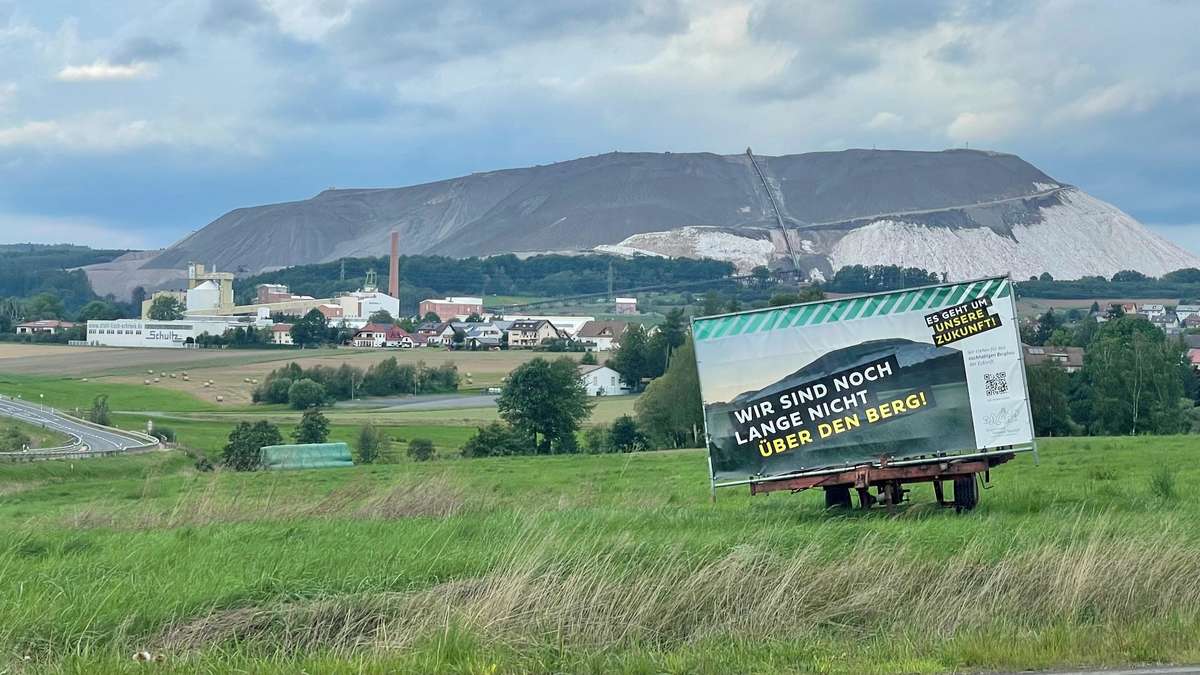

After the Kassel regional council (RP) gave the all-clear regarding the question of whether the drinking water in Neuhof was threatened by salinization, the citizens' initiative (BI) has now spoken out.
Neuhof – “The environmental Neuhof citizens' initiative criticizes in clear terms the representation of the Kassel regional council, according to which 'currently' There is no evidence of a risk to the Neuhof municipality's drinking water production facilities due to the entry of waste dump water “existed,” says a press release from the BI.
The background is a long-simmering debate about the question of whether the salinization around the Kaliberg in Neuhof could endanger the drinking water supply. The BI had an expert it had commissioned speak at an information event in January. He believes it is likely that the salt will spread so far that it reaches the wells. According to Neuhof's mayor Heiko Stolz (CDU), this representation had partly led to fear among the population.
BI Neuhof contradicts the authorities in the drinking water debate
K+S had contradicted the expert's forecast and stated that there was no evidence that drinking water wells were endangered by the dump. A few days ago, the RP also made a similar statement: “Based on the available monitoring data, there are currently no indications of a threat to the municipality's drinking water production systems,” the authority announced.
According to BI, this attitude ignores the development of salinization in recent years. “Since the beginning of the dump filling, three drinking water wells have had to be abandoned due to salinization: the Alte Wiese deep well, the Dorfborn well and the Heiligenrain well. The Heiligenrain well was shut down in 2012 after the salinization had flowed under the Lützbach – according to scientific analysis, this is evidence that natural bodies of water do not necessarily represent a barrier to the spread of salt water, as the RP claims,” says the BI.
From the BI's point of view, the RP consciously states that there are “currently” no indications of a threat. “Even the RP’s statement does not indicate that risks to further drinking water intakes have been ruled out,” said the BI.
The BI also contradicts the RP's representation that the Kemmete and the Lilac would form a natural hydraulic barrier or a separating drainage corridor between the wells and the heap: “The salinization of the Heiligenrain well shows that saline water can migrate under flowing water. In addition, the geoelectrical measurements of recent years show salt plumes near the surface in almost all directions of the heap – an indication of complex ones Flow paths that have not yet been adequately investigated or modeled.” In the past, however, K+S had repeatedly emphasized that the area surrounding the dump was not contaminated with salt across the board, but only in localized areas.
The BI also criticizes the fact that the monitoring cited by the RP is not preventive but reactive. The initiative therefore calls for, among other things, a forecast of the spread of salinization, an independent examination of the heap body, an independent feasibility test for dismantling the heap with the material being transported underground, a consolidation of the measuring points north, northeast and south of the heap, and a significant expansion of the geoelectric measuring routes.