ruth901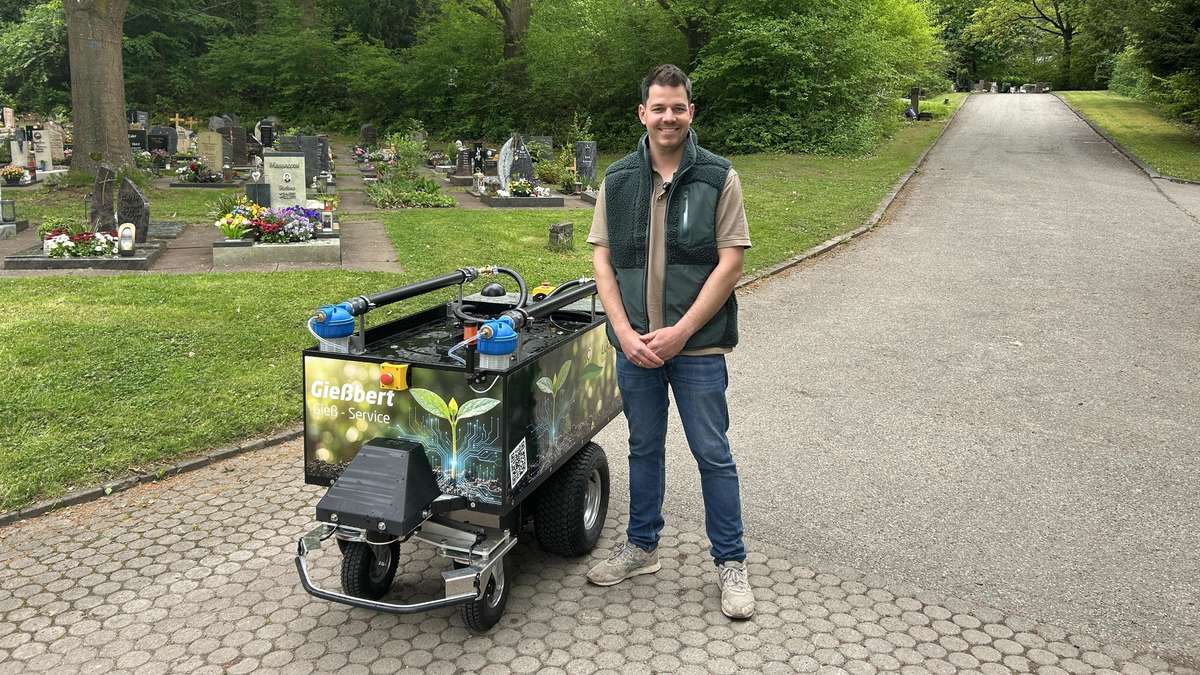

Lukas Kümmel has a new employee: “Gießbert”. The robot irrigates 400 graves at the Frauenberg cemetery in Fulda. Completely autonomous. According to Kümmel, there are only around 30 to 40 of them in the whole of Germany.
Fulda – “Gießbert” is still being trained. He's the “new guy” at the cemetery – but after just two weeks he's pretty popular. An older lady walks past him and smiles at the robot. “That's great! I need that at home too!” she says. No wonder: everyone who has a garden knows that watering is a lot of work. Especially since drought is becoming more common.
Bssssssss. “Gießbert” rolls quietly across the meadow. His goal: the double grave at the back of the row. The robot stops there and sprays fine jets of water from its nozzles. The grave turns from red to green on Lukas Kümmel's PC. The map shows where his “employee” has already been and where he still has to go. The Frauenberg Cemetery in Fulda is a total of twelve hectares in size and has more than 5,000 graves there – “Gießbert” looks after a good 400 graves.
Gießbert: Robot waters graves in Fulda cemetery
While his boss checks the routes, the green box on wheels drives calmly to the water station: to refuel. The tap opens – everything runs automatically. The tank contains 250 liters of water.
“We normally water twice a week in the summer. Two of my people spend 40 hours a week doing this. The watering robot takes so much work off of us that we can reduce that to around 15 hours, during which we have to water by hand in some places. This saved us three full days of work,” calculates Lukas Kümmel. The 30-year-old runs a grave and landscape maintenance business with six employees in Künzell-Dirlos.
The robot is not intended to cut jobs, but to save resources. “In dry summers, we work overtime. Watering has to be done, otherwise the plants will die. The robot allows us to avoid overtime or do other work with the time we save,” he explains.
The robot works at night. This means we only need half the water and conserve our most valuable resource.
The new “employee” also relieves the physical strain on his colleagues. “When watering we often stand in the sun, the UV radiation increases. The heat also causes problems.” The robot also makes the work of a cemetery gardener – which, by the way, is a training and master craftsmanship – much more attractive. “It is becoming increasingly difficult to get young people interested in green careers or in skilled trades in general,” says the entrepreneur. “Topics like robotics make the profession more interesting and future-proof.” Artificial intelligence is partly built into the machine and it is operated entirely electrically with solar energy, just like the two water filling stations. The robot is charged during the day – so it can do its work at night.

The fact that cemetery visitors get to see “Gießbert” is currently the exception. “During the day, water evaporates from the sun. At night it has time to slowly seep into the ground,” explains Kümmel. “By watering at night you save half the water, and that is our most valuable resource.”
In addition, the robot does not get in the way of visitors at night when the cemetery is closed. The machine is also harmless to animals. “It uses sensors to detect obstacles and wouldn’t even drive around a milk carton,” describes Lukas Kümmel.
“No more carrying water” – the only watering robot in all of Hesse
The casting robot is the only one of its kind in all of Hesse, “so we have a pioneering role,” says the Dirloser. The machine was manufactured by a company in Regensburg – so it is Made in Germany. Lukas Kümmel doesn’t want to say how much “Gießbert” cost. By the way, stealing the robot wouldn't be worth it – similar to a debit card, you can block the server so that it becomes unusable for third parties.
If you want to book “Gießbert”, you pay 120 euros per year. “Those for whom we water are incredibly grateful. Many are older and simply can't carry water anymore. And in general, many people say that they don't want to be a burden to anyone after their death and that the grave shouldn't be a lot of work for their relatives. We're also taking this development into account.”
In the future, Kümmel can imagine purchasing more robots to water for him at other cemeteries – in Petersberg, for example, he and his team look after 200 graves. His company also offers complete grave maintenance. However, there are no robots to plant graves yet, he says. But who knows what the future will bring.
Recently, thefts of grave decorations in cemeteries have increased in the Fulda district. This resulted in extensive property damage.