ruth901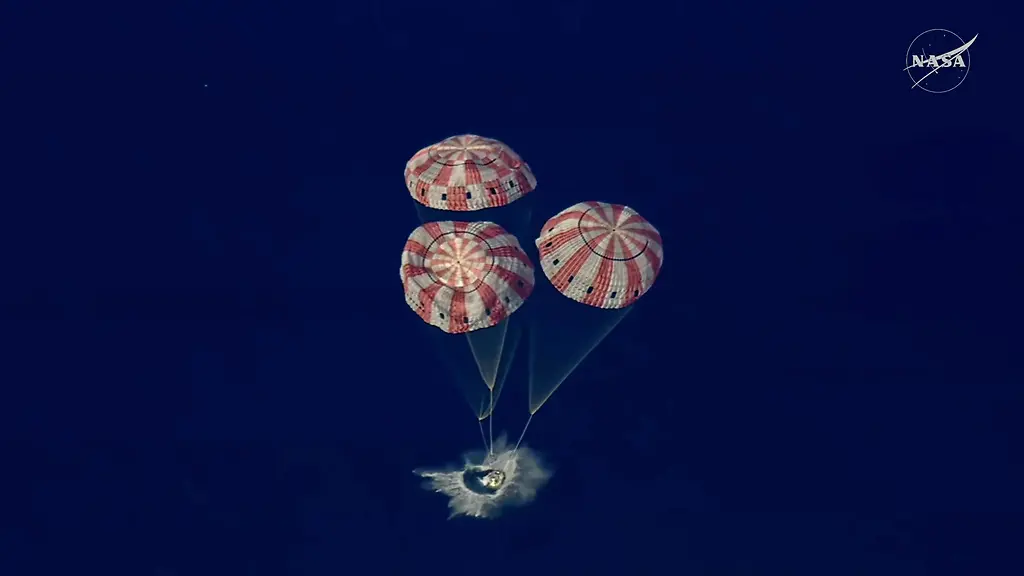
Artemis mission ends successfullyAstronauts land safely on Earth after flying to the moon
Successful landing after a historic mission: For the first time in more than 50 years, humans were near the moon again. They saw the unseen and set records. Now they are back on Earth after a dramatic return flight.
The first people to be near the moon in more than 50 years are back on Earth after around ten days in space. The four “Artemis 2” astronauts on board the “Orion” capsule landed as planned in the Pacific at 5:07 p.m. (local time; Saturday 2:07 a.m. CEST), the US space agency Nasa announced. It was a “picture-perfect landing”.
Special forces from NASA and the US Department of Defense helped the astronauts out of the capsule and then took them by helicopter to a special ship. NASA boss Jared Isaacman personally received them and congratulated them on a “historic achievement.” The astronauts waved and smiled at the cameras and gave the thumbs up. NASA said the crew was “healthy and happy.”
The return flight to complete the ten-day mission took place under extreme conditions: When re-entering the Earth's atmosphere at a speed of more than 38,000 kilometers per hour, the Orion spacecraft was exposed to temperatures of more than 2,700 degrees Celsius – a huge challenge for the heat shield. As expected, communication between the control center and the space capsule was interrupted for around six minutes.
The four astronauts – the Canadian Jeremy Hansen and the Americans Christina Koch, Victor Glover and Reid Wiseman – took off from the Cape Canaveral spaceport in the US state of Florida last week on board the “Orion” capsule with the “Space Launch System” rocket system. It was the second flight into space for Glover, Koch and Wiseman, and the first for Hansen. Koch became the first woman aboard a NASA lunar mission, Glover the first non-white person and Hansen the first Canadian.
US President Donald Trump congratulated the astronauts. “Congratulations to the amazing and very talented crew of Artemis 2,” Trump wrote on his online platform Truth Social. “The entire journey was spectacular, the landing was perfect, and as President of the United States I couldn’t be prouder.” Trump invited the astronauts to the White House and announced a trip to Mars as a future goal: “We will do it again, and then, next step, Mars!”
The flight path of “Artemis 2” resembled a figure eight around the Earth and the Moon. The four astronauts traveled a total of more than 2.3 million kilometers. They flew around the moon and went further from Earth than humans had ever done before. With their “Orion” capsule they broke the record of around 400,171 kilometers set by the “Apollo 13” mission in 1970. At their furthest point they were around 406,771 kilometers from Earth. They approached the moon to around 6,545 kilometers. A landing was not planned for this mission.
During their flight around the moon, the astronauts observed the celestial body particularly intensively for around seven hours. Particularly on the far side of the moon, due to the solar conditions, they were able to see things that no human had ever seen with their own eyes. As expected, the astronauts were unable to communicate with the control center on Earth for around 40 minutes.
Towards the end of the moon flyby, the astronauts – wearing special glasses – were even able to observe a solar eclipse, during which the sun disappeared behind the moon from the perspective of “Orion”.
The first person to walk on the moon was Neil Armstrong on July 20, 1969. Nasa astronaut Eugene Cernan, who died in 2017, was the last person to leave Earth's satellite on the “Apollo 17” mission in December 1972. In total, the USA was the only country to date to bring twelve astronauts to the moon with the “Apollo” missions between 1969 and 1972.
NASA's long-term goal is to build a permanent lunar station. Flights to Mars will start from there. The entire “Artemis” program has cost at least $93 billion since 2012, experts estimate.
NASA is increasingly relying on suppliers from the private sector. The heavy-lift rocket SLS, which transports the “Orion” space capsule into space, was developed by the US companies Boeing and Northrop Grumman. Lockheed Martin is building the capsule. The space companies SpaceX and Blue Origin owned by billionaires Elon Musk and Jeff Bezos are competing for the contract for a future lunar module.
German companies are also making a contribution: the service module of the “Orion” capsule, which houses the engine as well as the water and oxygen tanks for the crew, is assembled in the Airbus factory in Bremen. Some of the measuring devices carried on the current flight also come from Germany.
Sources used: mau/dpa/AFP/rts