ruth901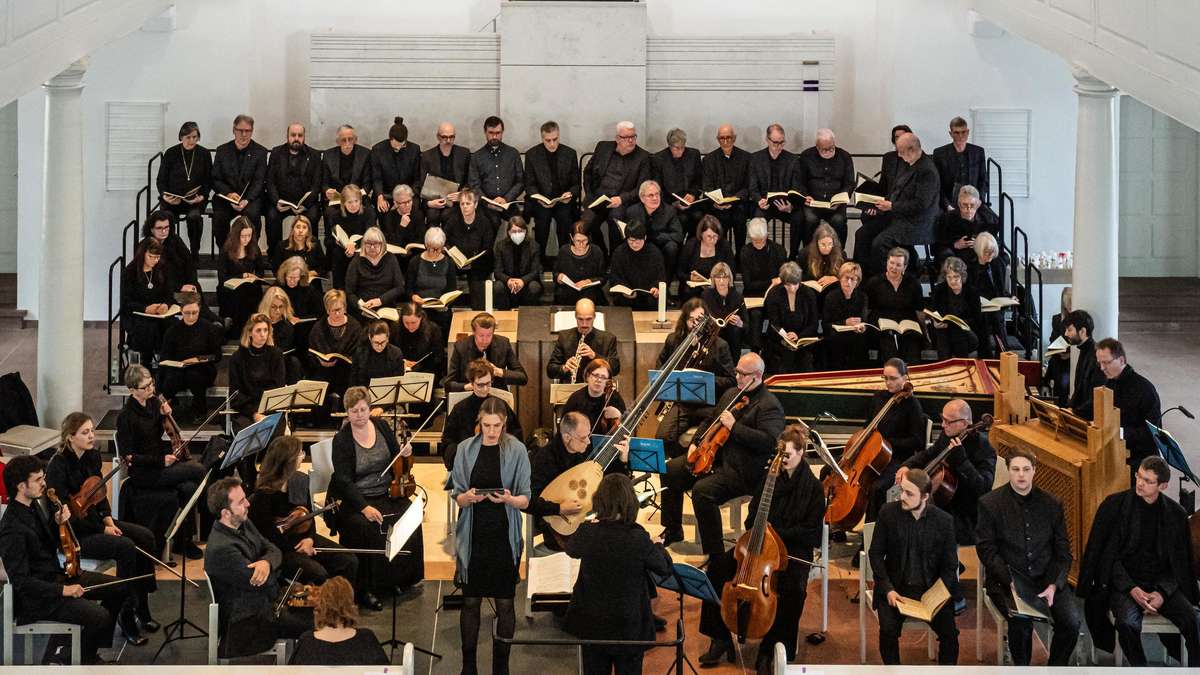

Dark, dramatic and powerful: The unabridged “John Passion” became an experience on Palm Sunday in the town church of St. Michael in Schlüchtern.
Schlüchtern – On Palm Sunday, the “John Passion” by Johann Sebastian Bach was performed in the town church of St. Michael in Schlüchtern. The oratorio tells the story of Jesus' passion according to the Gospel of John: from his capture, interrogation and condemnation to crucifixion and burial.
The Mannheim Chamber Philharmonic begins with a dark, dramatic introduction, the extended choir of the Schlüchterner Kantorei begins powerfully, almost relentlessly, singing: “Lord, our ruler, whose glory is glorious in all lands…” The few lines of the opening song are repeated, varied and expanded for a long time in polyphony. The haunting orchestral and vocal sounds already condense the following two-hour Passion Way with tremendous force.
Bach's St. John Passion captivates the audience in Schlüchtern
Then the evangelist appears as a narrator, not as a figure of John: “But Judas, who betrayed him, also stood with them.” These “spoken songs” by tenor Stephen Matthews accompany and shape the action throughout. Despite his matter-of-factness, his intonation is very warm. He also alternates as narrator and sings arias, sometimes after a short break immediately following a recitative.
Bass soloists appear alongside him, singing declaimingly as Jesus, Peter or Pilatus (Markus Lemke, Florian Franke), twice also singing alternately with the choir. A soprano (Martje Grandis) joins the flute, harpsichord and cello very emotionally: “I, too, follow you with joyful steps…”
The alto voice (Malina Höfflin) also takes on arias: “It is accomplished. O consolation for the offended souls…” All of these hymn-like insertions enable the audience to pause and empathize. To name all eighty participants would go beyond the scope, but the total work of art, led by district cantor Dorothea Harris, is supported by everyone involved.
While the arias pause, the choir takes on various tasks. He is the opening choir that opens the oratorio. Then follow chorales that calmly and reflectively invoke the community throughout or praise and sensitively defend Jesus: “Christ, who saves us, has committed no evil…”

Or the singers act as a turba choir (crowd) at the cruel climax of events: brutal and populist. “We have a law, and according to the law he shall die…” they cry. Sometimes, especially in the powerful parts, the choir singing is difficult to understand – but the sounds are so intense that they become more noticeable than the pure words.
In the renovated St. Michael's Church, the oratorio sounds magnificent – as if the erosion of the wooden beams and pews had given the tones new clarity. The “spoken songs” give the event an unexpectedly contemporary coloring in places. However, the harshness of the Turba choirs has a much stronger effect: “Away, away with him, crucify him!” These inflammatory calls, delivered in singing, become a threat that seems frighteningly present.
“Lord Jesus Christ, hear me, I will praise you forever…” The chorale at the end of the Passion Way is uplifting – a “real stream” that really lifts you up, gives you hope and gives you strength. The sky also takes part and, shortly before the end, sends strong rays of sunshine onto some singers through a church window. (By Hanswerner Kruse)
Also The Fulda Orchestra recently caused a stir with a performance of Mahler's Sixth Symphony and a specially built hammer.