ruth901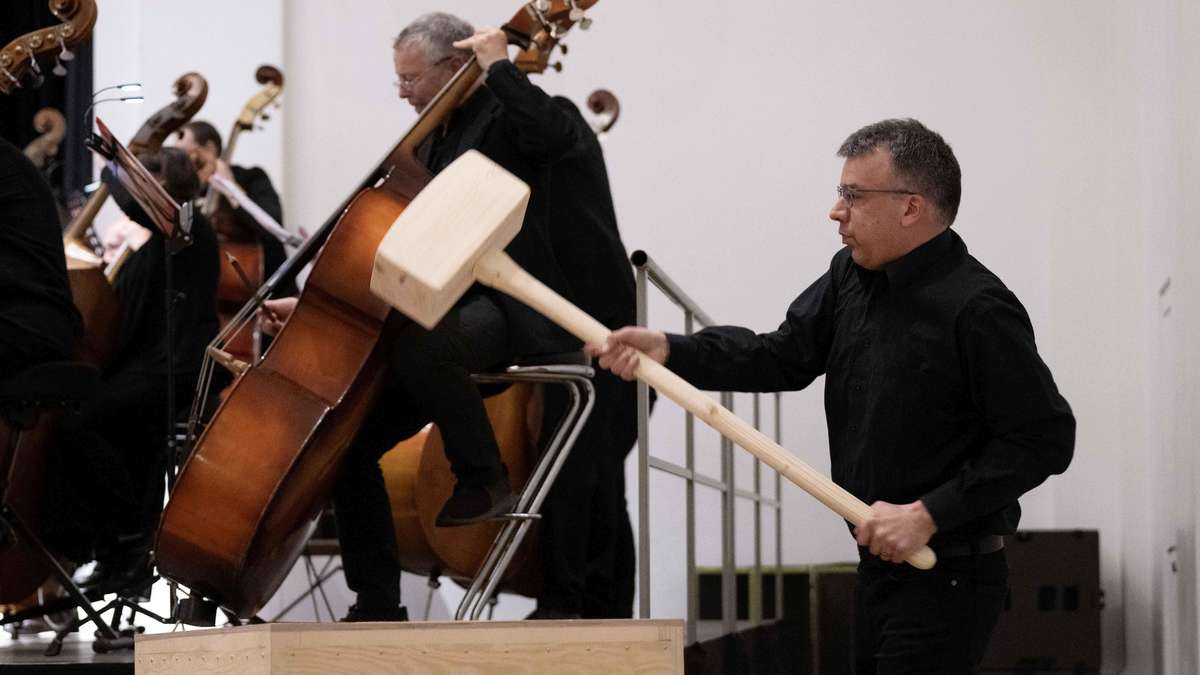

120 musicians, a specially built hammer and Mahler's sixth symphony: the 25th benefit concert of the Fulda Symphonic Orchestra was an extraordinary event.
Fulda – When the millipede was asked how he would coordinate his many little legs, he was a no-brainer. Because when he consciously thought about the movement, he could no longer walk. Was the Fulda Symphonic Orchestra (FSO) clear in advance, down to the last detail, what it was putting on its 240 legs at its 25th charity concert on Sunday evening (March 22nd)? Doesn't matter. It dared a lot, it won across the board. Or, to stay with the metaphor: Things worked. And round.
Mahler's sixth symphony, the “Tragic”, was on the program: a composition premiered in 1906 that features more than a hundred instruments. This size exceeds any “normal” ensemble and overwhelms many stages. Not to mention the hammer required in the final movement.
With 120 musicians and a hammer: Mahler's sixth symphony in Fulda
But the conductor Simon Schindler did not allow himself to be intimidated by all of this, especially since the FSO, as a project orchestra per se, has a very impressive number of musicians. Together they took on the challenge. At the end everyone left the town hall very satisfied, including of course the numerous listeners. Because whether active or passive: whoever was there experienced something special.
In four movements, Mahler musically explores an emotional range that slips irretrievably further and further into the dark, into the pessimistic and absorbs any bright moments. There is nothing reserved or cautious here, on the contrary. An existential pull pulls all musicians and all guests into the depths until, almost literally, the hammer falls three times.

This monument of music history, which has been and continues to be interpreted a lot – Mahler is said to have prophetically anticipated his own fate and/or the First World War – was experienced in Fulda with an astonishingly clear joy of detail. Because no matter how crowded the musicians were on the stage, which was enlarged to the front and back – and by God, that might have been tight! – they made all the sound elements sound so clearly, no matter how delicate they were.
The huge string section of the FSO gave space to the two harps, the striking brass to the triangle, the huge drums to the herd bells. Because the hammer is certainly not Mahler's only unusual instrument.
The orchestra followed Schindler's conducting with great concentration. The repeated abrupt changes in mood and tempo are achieved precisely, the musical effects were never lost, especially not the famous three hits with the hammer. Incidentally, this and the unspectacular-looking resonance block were specially built by FSO members. The dark, dry tone did not fail to have an effect.
As powerful as the performance was, it did not rely on extreme acoustic overwhelm. So the nevertheless moved audience was only too happy to follow the orchestra along the complex, interconnected paths of Mahler. The final applause was correspondingly long and loud, with the guests cheering while standing. Afterwards, many interested parties gathered, especially around the hammer.