ruth901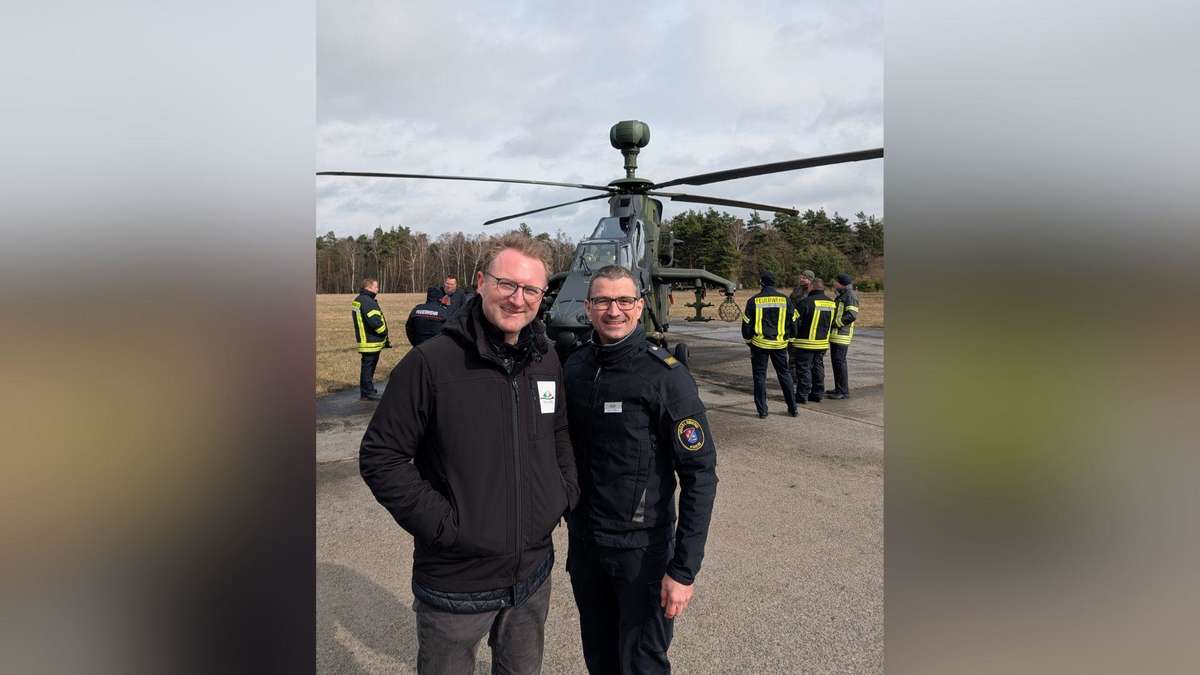

Fire brigade leaders from Vogelsberg practiced emergency situations with the Bundeswehr – the scenario was a crashed attack helicopter.
Kirtorf – A Bundeswehr helicopter crashes over the Vogelsberg district – a scenario that no one wants to experience, but for which rescue workers must be prepared. In order to work together smoothly in an emergency, around 40 representatives of the local fire brigades and the emergency response office met on Wednesday (March 11th) at the Herrenwaldkaserne training area near Kirtorf. The 36th Combat Helicopter Regiment from Fritzlar invited people to the Bundeswehr's large-scale aircraft accident alarm exercise.
Emergency exercise in the Vogelsberg district with the Bundeswehr
The background to the four-hour training has a very practical connection to everyday fire service life: If a Bundeswehr aircraft has an accident away from military properties, it is almost always the municipal fire departments that arrive at the scene of the accident first after the alarm is raised. These crucial first minutes are about rescuing people, containing fires and immediately securing the scene.
Only when the specialized Bundeswehr fire brigade arrives at the scene of the accident will responsibility and operational management be transferred to the military. It was precisely this interface and the orderly handover that were the focus of the exercise, in which the scenario of a crashed Tiger attack helicopter was played out.
The proceedings were followed by a delegation from the Vogelsberg district. In addition to District Administrator Dr. Jens Mischak and Kirtorf's mayor Christoph Lück also got a picture of the situation from district fire inspector Marcell Büttner, district fire chief Andreas Leinweber, two specialist advisors from the Office for Hazard Prevention and various heads of fire departments from across the district. They watched closely as the regiment's emergency services arrived and the Bundeswehr fire department took over the professional rescue.
District delegation emphasizes importance of civil-military cooperation
Following the simulated part, two helicopters landed on the training area. This gave the civilian managers the opportunity to talk directly to the pilots. Specific sources of danger associated with a combat helicopter were explained on the machines themselves – technical knowledge that can be vital for civilian rescuers in action.
District Administrator Mischak and the representatives of the fire departments drew a consistently positive conclusion and thanked the Bundeswehr for the informative insight. The exercise clearly showed how essential civil-military cooperation is – both in disaster relief and in national and alliance defense. The conclusion of the district delegation: A real operation can only be successfully managed if all aid organizations involved, whether civil or military, communicate on an equal footing and work hand in hand.
The fact that rescue workers must be prepared for unusual situations at all times was recently shown again: On Friday morning (March 13th) an empty canoe was discovered on the Nidda reservoir in Vogelsberg – There has been an operation there ever since.