ruth901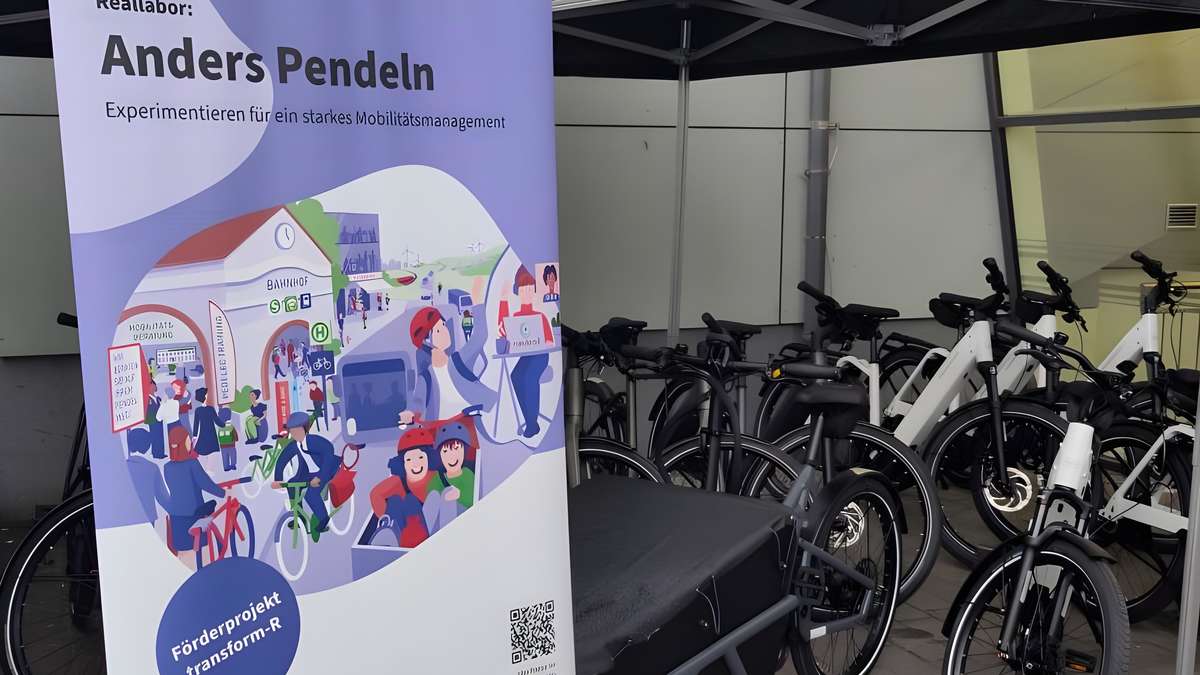

Commuters in the Main-Kinzig district are testing new mobility concepts. E-bikes and public transport are intended to make the commute to work easier. The experiment could change everyday life.
Schlüchtern/Gelnhausen – Many people experience traffic jams, stress and the arduous search for a parking space on their daily commute to work. But how can commuting mobility be made more pleasant? The participants in an experiment in the Main-Kinzig district are investigating this question Hesse.
Real-world laboratories for sustainable mobility offer the opportunity to develop new everyday habits. The transform-R research project, supported by the Institute for Social-Ecological Research (ISOE), supports several such real-world laboratories in Hesse that deal with commuting and excursion mobility.
The “Commuting Differently” experiment starts on June 16th in Gelnhausen
In the Main-Kinzig district, citizens have the opportunity to switch to environmentally friendly and socially acceptable means of transport. The Main-Kinzig district traffic company (KVG) is carrying out the experiment in cooperation with the ISOE. This is what the Main-Kinzig district reports. The bicycles will be handed over to the participants on June 16th in Gelnhausen and on June 18th in Maintal.
“We hope that the commuting experiment will enable participants to discover the advantages of sustainable mobility and encourage other citizens in the region to try out alternatives to cars,” explains Jannik Marquart, district councilor and head of the district traffic department.
Switching to new means of transport is not always easy. How about trying alternatives to usual driving? The real laboratory offers this opportunity. A total of 59 people from the Main-Kinzig district will take part in the project in the coming months.
As part of the KVG and ISOE commuting experiment, 44 people tested an e-bike, twelve an e-cargo bike and twelve tested local public transport, with nine of them combining this with an e-bike or e-cargo bike. The bikes are handed over by the contractual partner Riese & Müller.
Due to the large number of participants and the extent of the Main-Kinzig district, the handover dates were set in the two largest cities in the district. Until the end of October, participants have the opportunity to get used to their new daily commute and develop new habits.
Background: Transform-R
The Transform-R project, initiated by the FrankfurtRhineMain regional association and funded by the BMFTR, aims to accelerate the energy and mobility transition in the Frankfurt Rhine-Main region. In addition to ecological aspects, the focus is on social factors and improving the quality of life.
The aim is to gain knowledge from “real laboratories” in order to implement the mobility transition more quickly. These findings are to be transferred to other municipalities in the form of transfer products and instruments for scaling. The project partners include the Goethe University Frankfurt, the ISOE and the Institute for Energy and Environmental Research (ifeu).
The city of Maintal showed great interest in the project during the application phase. No wonder that many participants live or work in Maintal. “Maintal is located between Frankfurt and Hanau – many people commute here, often by car. The commuting experiment is intended to help show that citizens of Maintal can easily get to work by bicycle and in combination with the city bus transport,” says Monika Böttcher, mayor of the city of Maintal.
“Changing a routine is the linchpin for sustainable everyday mobility,” emphasizes Luca Nitschke, mobility researcher at ISOE. “This change involves a sometimes intensive adjustment and many questions that we want to address with the participants during the pendulum experiment.”
Questions like: What is the best way to get to work by bike? What equipment do I need to be able to transport everything in any weather? How long does the new commute take and what other everyday journeys can I manage without a car? As part of the experiment, the answers that the participants find will also be passed on to citizens and those responsible for planning in the region.
Video: Hesse's most busy roads
The mobility experiment is part of the practice-oriented research project transform-R and is being implemented with the FrankfurtRheinMain regional association. “For us, it’s not about theory, but about doing things: trying things out, testing new approaches and initiating concrete improvements on site,” says Rouven Kötter, First Alderman and Head of the Mobility Department of the FrankfurtRhineMain regional association.
“We want to create opportunities so that switching to bicycles, buses and trains really works in everyday life. Mobility has to be fun, but at the same time safe, reliable and comfortable – only then will it be accepted. The mobility experiments provide exactly the insights we need to better link these offers and make them more attractive step by step.”